Dubai occupies a distinct place among luxury destinations. It’s compact, modern, and built for five-star ease, with pockets of Emirati and Bedouin tradition still close at hand. For travelers flying from the Philippines, the appeal runs deeper than the skyline. Direct flights connect Manila and Cebu to Dubai, a large Filipino community is already rooted in the city, and a recent change to entry rules has made the destination considerably more approachable for a first private-tour trip.
A custom UAE itinerary is rarely just Dubai. Most journeys pair the city's landmarks and shopping with a desert excursion and an Abu Dhabi extension, giving the trip both a futuristic register and a quieter, more traditional one. Built privately, the whole arc, city, desert, and capital, moves at a single, considered pace rather than three separately booked experiences stitched together.
Suggested Itinerary Highlights
Our own Meet Dubai & Abu Dhabi journey traces a route that reflects how most well-built private UAE itineraries flow: a Dubai landmarks day, a full-day Abu Dhabi excursion, and time set aside for shopping before departure. A few highlights are worth building any custom version around.
Modern Dubai is anchored by the Burj Khalifa and The Dubai Mall, including the Dubai Fountain show, alongside the Museum of the Future and the Dubai Frame for architectural photo stops.
Old Dubai carries the city's slower, older character: the Al Fahidi Historical Neighbourhood, an abra ride across Dubai Creek, and the Gold and Spice Souqs.
Coast and icons round out the city side, with Jumeirah Beach, a photo stop at the sail-shaped Burj Al Arab, and Palm Jumeirah, viewed from The View at the Palm or Atlantis The Palm.
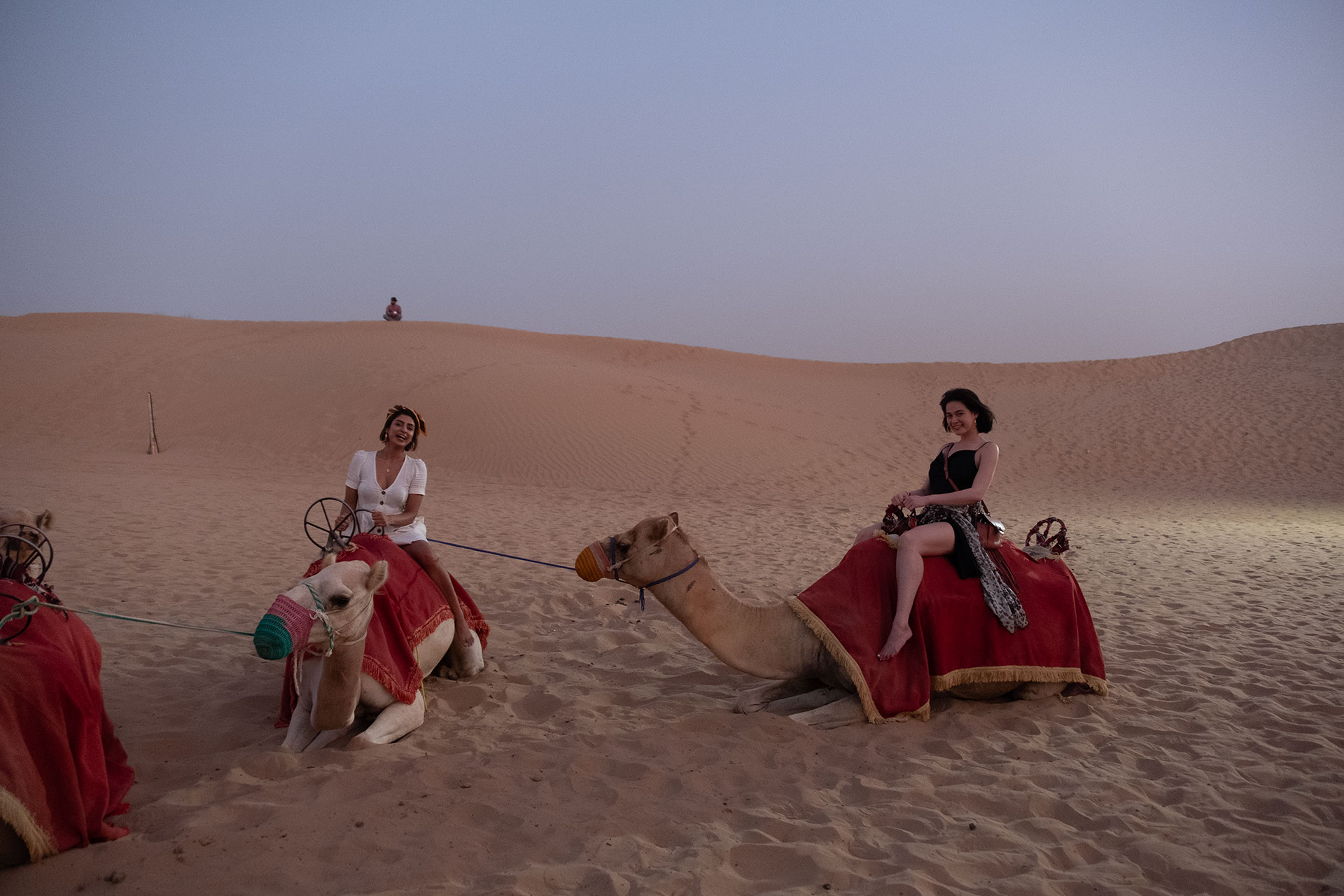
The desert is where the pace changes entirely. A 4x4 desert safari typically includes a Bedouin-style camp, camel rides, and a barbecue dinner with traditional entertainment under open sky.
Abu Dhabi brings the Sheikh Zayed Grand Mosque, Emirates Palace, and the Corniche waterfront, often paired with Ferrari World or the Louvre Abu Dhabi for travelers with a full day to spend.
For travelers with more time, longer private itineraries can extend to Sharjah and Ajman for a deeper look at Emirati heritage sites and souks outside Dubai's tourist core.
Duration & Best Time to Visit
Most private Dubai and UAE itineraries run five to seven days, enough to cover the city's core sights, a full Abu Dhabi day trip, and a desert excursion without rushing. Extending to seven to ten days makes room for Sharjah, Ajman, or a few added leisure days.
Weather is the deciding factor for timing, and it points firmly in one direction. November through March is peak season, with mild temperatures and minimal rainfall, ideal for outdoor sightseeing and desert excursions. October and April serve as shoulder months, warmer but still comfortable, with better rates than winter. May through September is low season, with temperatures well past 35°C and high humidity, when sightseeing shifts largely indoors in exchange for quieter crowds.
Late October and early April tend to be the practical sweet spot for travelers who want lower peak-season rates without the extreme summer heat. January and February carry an added draw for shopping-focused travelers, coinciding with the Dubai Shopping Festival.
Filipino passport holders should also factor in a recent change to entry rules. Since June 25, 2026, travelers who hold a valid visa, residence permit, or Green Card from the United States, an EU member state, the United Kingdom, Australia, Japan, Singapore, South Korea, Canada, or New Zealand can obtain a visa on arrival in the UAE, either a fourteen-day option at AED 100, extendable once for a further fourteen days at AED 250, or a non-extendable sixty-day option at AED 250. Travelers who do not hold one of those qualifying documents still need a UAE tourist visa arranged in advance, which typically takes three to four business days to process. Access Travel handles either path as part of a custom itinerary.
What's Included
A private Dubai and UAE package is built to remove the logistics rather than just the sightseeing. Across our own itineraries and the wider market of private operators, a well-constructed package generally bundles private airport transfers, often with expedited immigration assistance, a private vehicle and English-speaking guide for the full itinerary, hotel accommodation, commonly at five-star properties in Downtown Dubai, entry visa processing and fees, entrance tickets to major paid attractions such as observation decks and museums, and select meals tied to specific experiences, like a desert safari barbecue or a dhow cruise dinner.
Usually left separate: gratuities, general daily meals outside specified experiences, optional add-ons such as At the Top Burj Khalifa access, and international airfare.
A boutique private operator's real advantage is the ability to swap or customize any part of the itinerary without renegotiating the whole trip, along with support once the journey is underway.
FAQs
Do Filipino travelers need a visa for Dubai and the UAE? Since June 25, 2026, Filipino passport holders who hold a valid visa, residence permit, or Green Card from the United States, an EU member state, the United Kingdom, Australia, Japan, Singapore, South Korea, Canada, or New Zealand can obtain a visa on arrival, either the fourteen-day or sixty-day option. Travelers without one of those qualifying documents still need a UAE tourist visa arranged in advance, which Access Travel can handle as part of a private itinerary.
What documents are required for a UAE tourist visa application? Applicants generally need a Philippine passport valid for at least six months, a recent passport-style photo on a white background, proof of onward or return travel, confirmed hotel bookings, and travel insurance. A five-year multi-entry visa additionally requires proof of at least USD 4,000 in available funds.
Is Dubai walkable, or do you need a car for a custom tour? Dubai's landmarks sit across distinct districts, Downtown, Jumeirah, Old Dubai, and Palm Jumeirah, so a private tour is built around vehicle transfers between zones rather than a single walkable core. A private guide and vehicle for the full itinerary is standard.
Should Abu Dhabi be a day trip or an overnight stay? Most private itineraries treat Abu Dhabi as a full day trip from Dubai, roughly ninety minutes each way, covering the Sheikh Zayed Grand Mosque, Emirates Palace, and the Corniche in a single day. Travelers who want Ferrari World or the Louvre Abu Dhabi at a relaxed pace may prefer building in an overnight stay instead.
What should travelers wear or pack for desert and mosque visits? Modest dress is required for mosque visits, covering shoulders and knees, with headscarves provided for women at most sites. Desert safaris call for comfortable, breathable clothing and closed-toe shoes, since sand and dust are part of the experience.
Ready to design a Dubai and UAE journey around your own pace? Get in touch with an Access Expert.